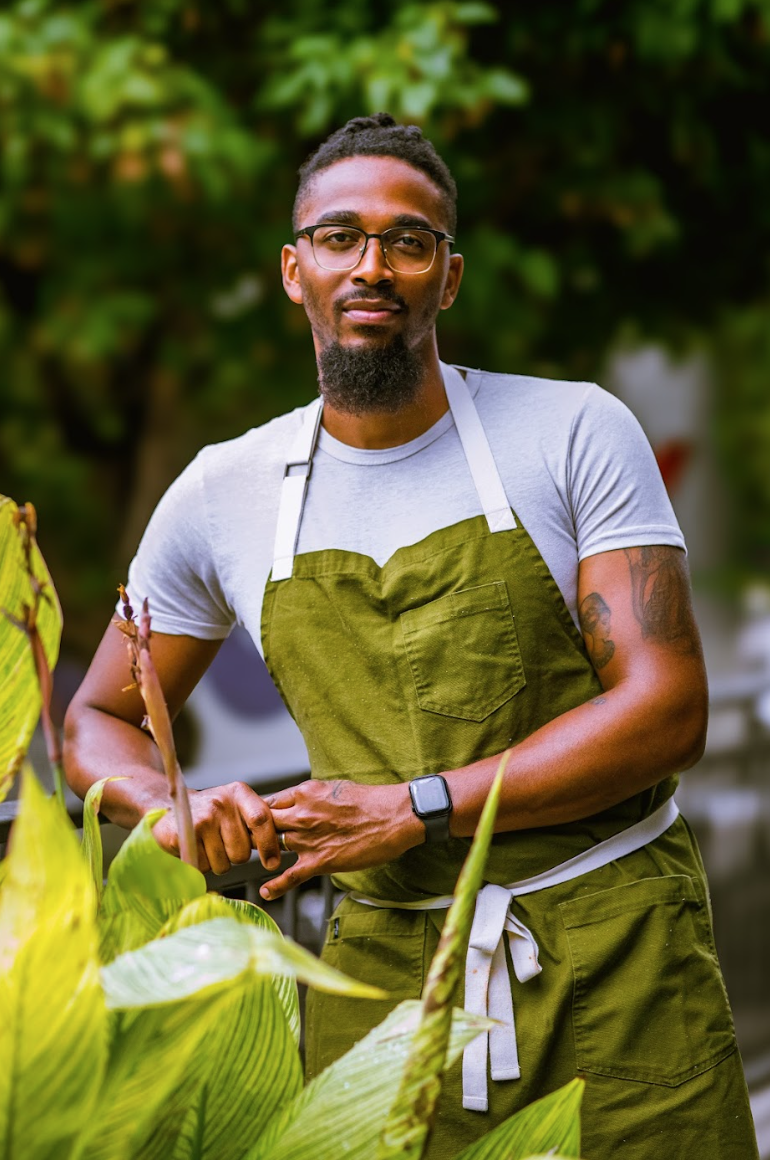
At Bread & Butterfly and Heritage in Atlanta, the Bellevue Hospitality co-founder is turning Trinidadian memory, West African foodways and Southern experience into a larger argument: Black cooking does not have to shed its identity to earn an ambitious room.
| Reading time | 11–13 minutes |
Editor’s note: This profile is based primarily on a Liberated Paths interview with Chef Demetrius Brown. His quotations have been lightly edited for length and clarity without changing their meaning. Restaurant details were checked against official sources on August 31, 2026 and should be reconfirmed immediately before publication.
In culinary school, Africa got a week.
That detail has stayed with Chef Demetrius Brown. His international coursework could move country by country through Europe, but the cooking of a continent with 54 nations was compressed into a lesson so broad it became almost meaningless.
“With Africa having 54 countries, we spent a week learning about the cuisine—quote, unquote—of Africa,” Brown told Liberated Paths. “I’m like, that’s not possible. You can’t cover that.”
The problem was not simply academic. A curriculum establishes which food traditions are complex enough to study, which techniques become professional vocabulary and which cultures are allowed to remain specific. Brown was being trained to enter a restaurant industry that could discuss Italy region by region while treating African foodways as one indistinct category.
He noticed the imbalance before he had the language or the professional freedom to answer it. Years later, during the pandemic, when building his identity became the focal point, the question returned with greater force: What would he cook if the restaurant industry’s inherited hierarchy no longer decided for him?
His answer became Heritage Supper Club, then a more permanent body of work. It runs through the menus at Bread & Butterfly, the Inman Park café and bistro Brown owns with restaurateur Brandon Blanchard, and through Heritage, their new Summerhill restaurant. Together, the two businesses make a case for culinary ambition grounded in the African diaspora rather than translated away from it.
Before the kitchen, there was a mechanic shop
Brown grew up inside several food cultures at once. On his father’s side, Trinidad and Tobago shaped the family table, with another line of influence from a Jamaican aunt. His mother’s family brought the cooking of Virginia and the Carolinas. In Providence, Rhode Island, Puerto Rican, Dominican and Guatemalan neighbors widened the circle further.
From that came exposure: the idea that a kitchen could hold multiple flavor systems without one canceling another.
Cooking was not yet the career plan. His father and grandfather owned a mechanic shop, and Brown grew up around cars and the satisfaction of working with his hands. He assumed he would become a mechanic. His grandfather saw something else: a child who loved to eat, who liked to cook and who might be able to turn that physical intelligence toward a different craft.
During a summer trip to Rhode Island, his grandfather suggested Johnson & Wales University. Brown returned home for his senior year of high school and applied to one college—the culinary school he had not previously imagined attending.
“I had never thought about cooking up until that point, professionally,” Brown said. Adapting made the possibility real. Restaurant work made it serious.
The route from engines to stoves is not as sharp a turn as it first appears. Both demand repetition, heat management, diagnostic attention and respect for systems. A cook, like a mechanic, learns that the smallest failure can travel through the whole machine. Brown’s early life taught him to trust his hands before the industry taught him its traditions.
The lesson that did not fit inside one week
Early in culinary school, Brown leaned toward Asian flavors—the part of restaurant culture that felt ascendant at the time. Then the international classes exposed a structural gap. What was presented as “African cuisine” could not account for the distinctions he had begun to understand between regions, histories and trade routes, much less the continent’s relationship to cooking in the Americas.
West African foodways, in particular, gave Brown a way to think about the foundations of Southern and African American cooking: tomatoes and peanuts, okra and greens, rice, stews, starches and the long movement of ingredients and techniques across the Atlantic. The connections were not neat or singular. They were evidence that the story of American food was larger—and more African—than the formal curriculum allowed.
Still, recognition did not immediately become a cooking philosophy. Brown moved through respected Atlanta kitchens, absorbing technique and learning how restaurants actually run. The official Heritage biography traces his path through The Hill at Serenbe and The Pinewood in Decatur, where he became executive chef. He was building a conventional résumé even as the food he wanted to make was becoming less conventional to the institutions around him.
The turning point came gradually. He began revisiting recipes made by his grandmother, aunts and uncles, then worked their logic into menus at the restaurant he led before the pandemic. The dishes were not nostalgic side projects. They started to reveal a point of view.
“I was just at home with my own thoughts,” Brown said. “That’s when I was like, this is the food. The food of Black people is the food I want to make from now on.”
It was a declaration, but also a business risk. Chefs are often encouraged to make personal food only after conventional success has made experimentation safe. Brown chose it when very little felt safe.
Cooking as preservation—and rebellion
“If you can tell a person that what they’re doing is barbaric, less than or uncivilized, they can begin to forget that culture and adopt a new one,” he said. “I think it’s a form of rebellion to cook this type of food. It’s also to keep traditions going.”
The word rebellion could sound theatrical in a dining room. Brown uses it more practically. Every family recipe that survives is a refusal of disappearance. Every chef who studies the differences among African and Caribbean traditions pushes back against the category errors that once flattened them. Every guest who sees those foods handled with care, without apology, receives a different picture of what belongs in American fine dining.
“As we get further and further away from our forefathers or our matriarchs in the family, we start to lose traditions,” Brown said. “Food and music are the two biggest parts of culture in any civilization, and I think preserving that is very important.”
Preservation, in his kitchen, does not mean freezing a recipe in time. Diasporic food has always moved—across oceans, borders, generations and whatever ingredients were available. The chef’s responsibility is not to make change impossible. It is to know what the change is carrying.
That distinction separates interpretation from erasure.
Nostalgia is a technique
Brown says he wants his food to produce nostalgia, even for a diner who has never eaten the original dish.
That response is central to Brown’s cooking. Familiarity is not the same as simplicity, and it does not require disguising an ingredient until a diner can no longer identify its origin. A dish can be technically exacting and emotionally immediate. It can teach without behaving like a lecture.
“Whether or not you know what ingredients we’re cooking with, whether or not you know the backstory, every single dish—I want it to feel familiar,” he said. “Regardless of your background, because the fabric of America is entrenched in Africa.”
The idea explains why Brown’s answer to a question about his favorite dish was not the most elaborate plate in his repertoire. It was mafé, the West African peanut-and-tomato stew he described with the delight of someone still surprised by it.
In Brown’s telling, the peanut is both subdued and amplified by tomato. Chicken gives the stew substance, but it can still eat lighter than its richness suggests. Rice, okra and sweet potato turn it into a meal. He called it “honestly life-changing,” then immediately emphasized how approachable it is to make.
That pairing—revelation and accessibility—is the point. Brown wants guests to understand that African and Caribbean food can be expansive without being alien. The route to that understanding is not to sand away the flavor. It is to offer enough care, context and pleasure that the unfamiliar begins to register as kin.

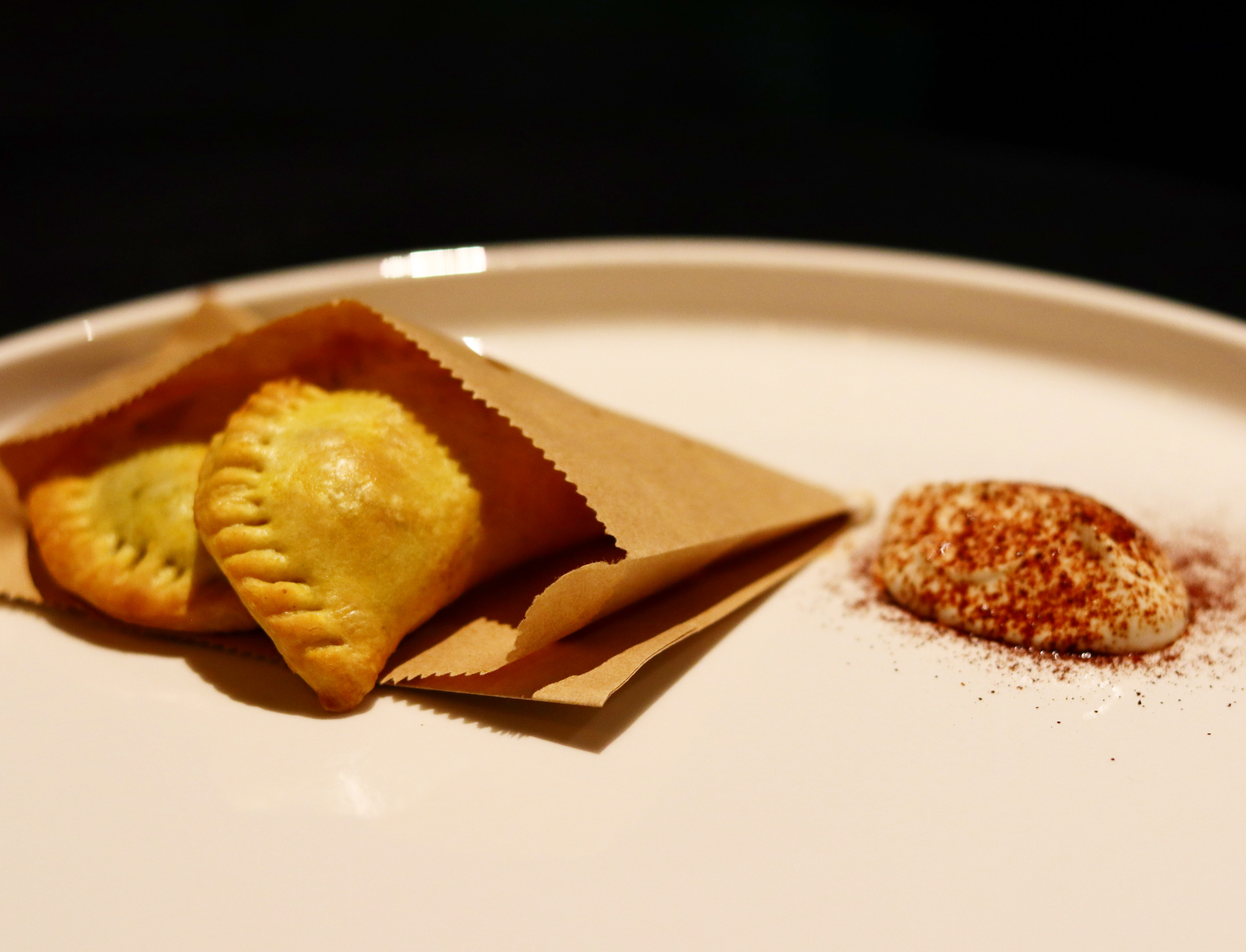
A plated course from Chef Demetrius Brown’s culinary portfolio. Confirm the dish name and photographer credit before publication.
Heritage is the room he once needed
When Brown described Heritage to Liberated Paths, he was close to opening the doors. His ambition for the restaurant was inseparable from a frustration: he had rarely encountered a polished dining room where food familiar to him was central, where Black guests could experience cultural recognition and occasion at the same time.
“I never had a place like what Heritage will be, where I can go and get food that I’m familiar with in a nice atmosphere, surrounded by people that look like myself,” he said.
The sentence reaches beyond menu development. Hospitality is partly the management of social comfort—who feels expected, who understands the codes of the room and who is made to feel that luxury belongs to someone else. Brown wants to alter that equation without making Heritage culturally closed. The goal is a room grounded enough in Black life to welcome widely without losing its center.
Heritage’s permanent home is in Summerhill, a historically Black neighborhood south of downtown Atlanta. The location makes the restaurant’s argument physical. This is not a concept about the African diaspora placed in a generic luxury district; it is a dining experience entering a neighborhood with its own Black history and an active independent restaurant corridor.
The movement through the building turns dinner into a narrative: welcome, reflection, celebration, continuation.
This is cultural access expressed as restaurant design.
Traveling to Atlanta—or trying to find the people and places reshaping your own city? Join Liberated Paths Connect to trade recommendations and build a more personal map of Black culture, hospitality and experience.

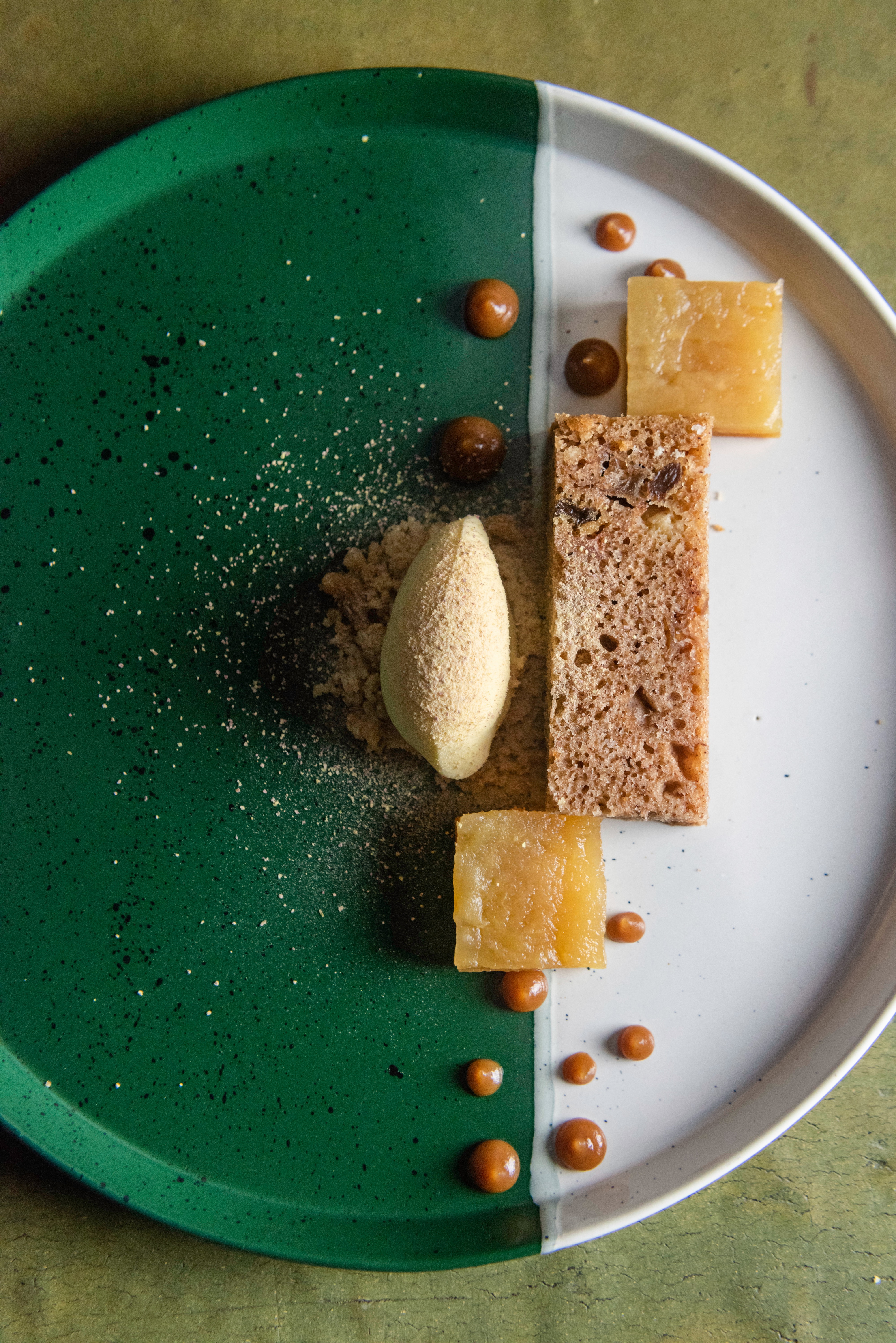
A dessert from Chef Demetrius Brown’s culinary portfolio. Confirm the dish name and photographer credit before publication.
Elevation without translation
Brown is candid about conventional ambition. He wants awards. He would welcome Michelin recognition. There is no virtue in pretending external validation does not affect reservations, investment, hiring and a restaurant’s chances of surviving.
But the award is not the mission.
“I really want to be the change in the culinary industry and in guest perception of what African food is, what Caribbean food is,” Brown said.
A cuisine should be allowed the neighborhood counter, the family table, the café, the tasting menu and every register in between. One form does not invalidate another.
Fine dining has historically presented elevation as a movement toward European standards: French vocabulary, hushed rooms, rare ingredients and a service style designed to signal exclusivity. Brown’s work proposes a different definition. Elevation can mean deeper research, sharper technique, better sourcing, more intentional design and more complete storytelling—while the food remains recognizably Black.
It can also mean comfort without compromise. The goal is not to make every guest immediately comfortable with every flavor. It is to create enough trust for curiosity, and enough cultural confidence that the restaurant does not negotiate against itself.
The inheritance runs forward
Brown’s story begins with the people who fed him: grandparents and great-grandparents from Trinidad and Tobago, family from Jamaica, Virginia and the Carolinas, neighbors in Providence, and the grandfather who noticed that cooking might become more than a pastime.
Heritage turns that inheritance outward. Brown wants to become a leading voice, but he also wants younger cooks to see a path that was not visible to him.
“If I can be a leading voice and an inspiration to younger cooks, that’s my main goal,” he said.
The most consequential part of a restaurant may be what it makes imaginable. A young cook can enter Heritage and see African, Caribbean and Afro-American food treated not as a theme night or a concession to trend, but as the intellectual and emotional center of the business. A Black guest can book an ambitious evening without wondering whether the room’s idea of sophistication includes them. A diner unfamiliar with the ingredients can discover that recognition does not always require prior knowledge.
That is why Brown’s culinary-school memory matters. Africa got a week because the institution did not know how to see its scale. Brown’s answer is not another survey. It is specificity practiced over time: a peanut stew that feels like revelation, a French café reconsidered through diaspora and a Summerhill restaurant built to hold a larger story.
Heritage, in this sense, is not only what has been handed down. It is the room the next generation inherits.
Know a chef, maker, host or cultural space creating the kind of experience more people should be able to find? Add your perspective to Liberated Paths Connect and help the community follow the path.
If you go
Heritage
Address: 63 Georgia Ave. SE, Unit A, Atlanta, GA 30317
Current posted hours: Tuesday–Saturday, 4:30 p.m.–10 p.m.
Format: An eight-course prix fixe menu that evolves daily and seasonally, plus an à la carte menu.
Reservations: Available through the restaurant’s official website and Resy.
Plan well: Confirm hours, menu format, pricing, reservation terms and dietary accommodations directly with the restaurant before visiting.
Official site: Heritage
Bread & Butterfly
Address: 290 Elizabeth St. NE, Suite F, Atlanta, GA 30307
Format: Café and bistro service during the day; dinner Thursday–Saturday at the time of verification.
Current posted hours: Lunch Monday–Wednesday 9 a.m.–4 p.m.; Thursday–Friday 9 a.m.–3 p.m.; Saturday 10 a.m.–3 p.m.; Sunday 10 a.m.–4 p.m. Dinner Thursday–Saturday 5:30–9 p.m.
Plan well: Service hours vary by day. Confirm the current schedule and menu before visiting.
Official site: Bread & Butterfly
About the interview
Liberated Paths interviewed Chef Demetrius Brown about his route into cooking, the culinary-school experience that pushed him to reconsider how African cuisines are taught, the role of food in preserving culture, the use of nostalgia in his dishes and his ambitions for Heritage. The interview is the primary reporting source for this profile. External sources were used to verify names, career chronology, restaurant ownership, addresses, posted hours, menu structure and current reservation availability.