
At the northern edge of Bronzeville, a traveler raises one hand toward Chicago. The other grips a suitcase. His coat is made from the worn soles of shoes, as if the journey north has become the material of the body itself.
Alison Saar's Monument to the Great Northern Migration stands near Dr. Martin Luther King Jr. Drive and 26th Place. It does not illustrate migration as an arrow on a map. It gives the movement weight: luggage, wear, uncertainty and an arrival that is both greeting and demand.
A thoughtful day on Chicago's South Side can begin here, move south to the DuSable Black History Museum and finish at Virtue in Hyde Park. The route is compact enough to complete without haste, but its subjects are larger than an itinerary. Treat each stop as an entrance, not a summary.
Begin with the traveler facing north
Between 1916 and 1970, roughly six million Black Americans left the South for cities in the North and West, according to the National Park Service. Chicago became one of the migration's defining destinations. New arrivals built businesses, newspapers, churches, political organizations, music scenes and family networks while confronting restrictive covenants, segregation, labor discrimination and violence.
Bronzeville became a Black Metropolis not because the city simply welcomed the migrants, but because Black Chicagoans created institutions within and against the boundaries imposed on them. Congress designated the Bronzeville-Black Metropolis National Heritage Area in 2023, recognizing a landscape of national consequence rather than a collection of disconnected landmarks.
At Saar's monument, walk around the figure. Notice that the surrounding bollards take the form of suitcases and that the traveler's body points north. Do not ask the sculpture to make migration inspirational without remainder. People moved toward possibility because conditions at home had been made intolerable; many encountered new forms of exclusion after arrival.
The monument is public and outdoors. Visit in daylight, remain alert to traffic at the intersection and keep the path open for residents. Allow 20 to 30 minutes—longer if traveling with someone whose family has a migration story to tell.
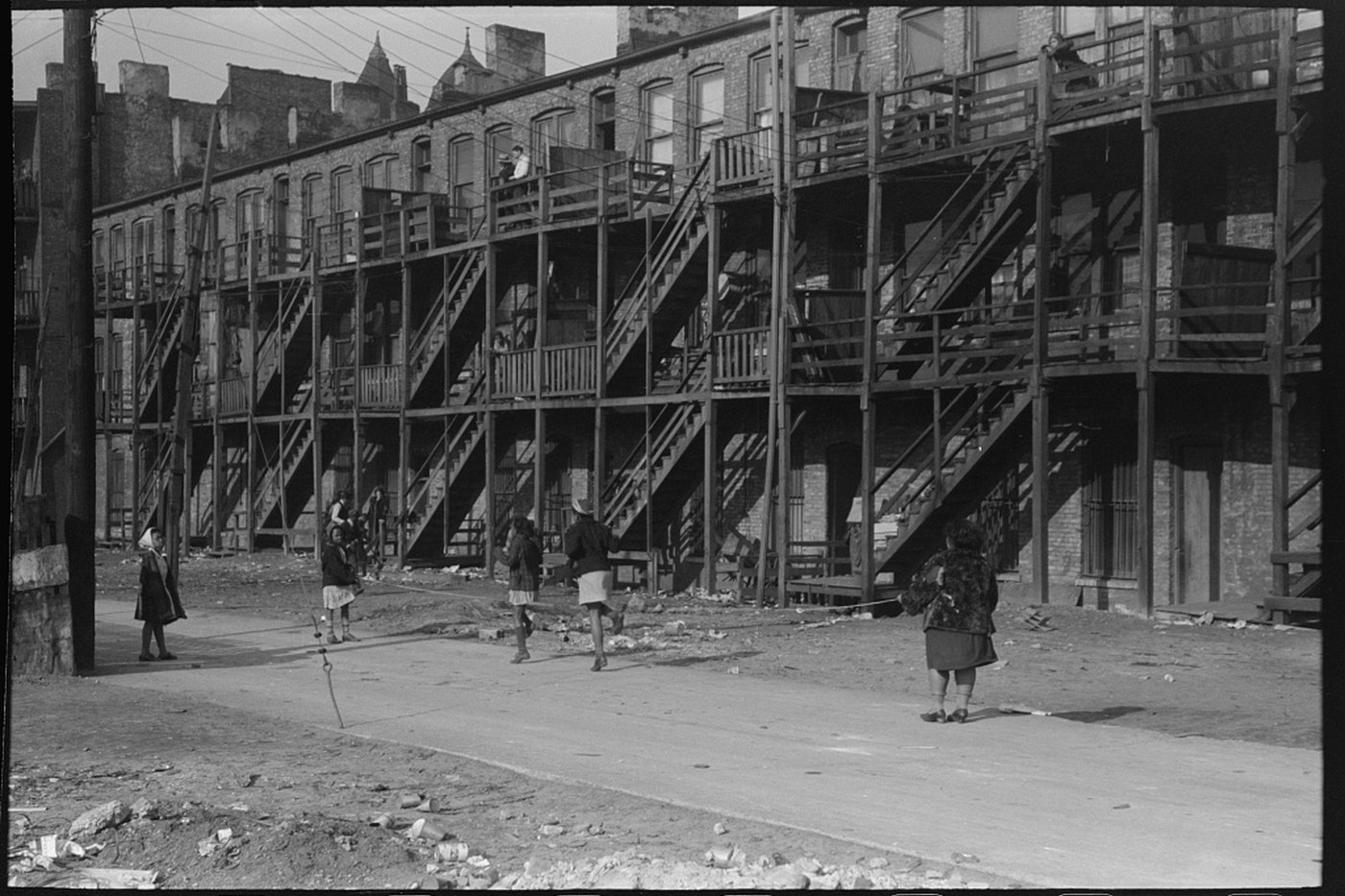
Read Bronzeville as a living neighborhood
From the monument, the route follows the larger corridor south. Architecture can invite looking, but private homes, houses of worship and everyday businesses are not an open-air museum. Photograph public art and landmarks thoughtfully; ask before photographing people.
The South Side Community Art Center, historically at 3831 South Michigan Avenue, is one of the essential institutions in this landscape. Founded in 1940, it describes itself as the nation's oldest African American art center. It nurtured artists, exhibitions and education from a building acquired and sustained by the community.
It is also currently closed for essential building maintenance and construction. Do not treat the closure notice as a suggestion to try the door. Follow the center's official calendar for satellite programs and reopening updates. The construction is a reminder that preservation is active work: historic institutions need capital, maintenance and room to change, not only praise after they become fragile.
This itinerary therefore does not include an interior stop at the art center. Naming the closure is more useful than writing around it, and more respectful than sending a traveler to an unavailable building.
Give the DuSable Museum the middle of the day
At 740 East 56th Place in Washington Park, the DuSable Black History Museum and Education Center provides the day's sustained encounter with objects and archives. Margaret Taylor Burroughs and her husband, Charles Burroughs, founded the institution in 1961 on the ground floor of their home. It began as the Ebony Museum of Negro History and Art, created to educate the public about Black history, culture and art.
That origin matters. The museum was not granted to Chicago from above. It began because Black collectors, artists, educators and neighbors decided that the historical record required a home.
The museum now reports holdings of more than 15,000 works and historical objects. Permanent material and temporary exhibitions can change, so consult the current exhibition page rather than arriving attached to a show mentioned in an older guide. Read the labels for provenance—who made an object, who saved it, who donated it—and notice where an individual life meets a collective movement.
The DuSable currently lists hours Tuesday through Sunday from 10 a.m. to 5 p.m., with last admission at 4:30 p.m. Tickets are timed, and its visitor page says gallery slots are limited to 90 minutes. Reserve online, then verify admission prices and current access policies; portions of the site still carry pandemic-era language that may not reflect the live experience.
Ninety minutes is enough for a focused visit, not the entire history of Black America. Choose one or two galleries to read closely. If visiting with children, let each person select an object to explain over dinner. If returning, build the visit around what has changed rather than repeating the same circuit automatically.
Leave room between archive and dinner
Washington Park and Hyde Park sit near each other, but the time before a dinner reservation should not become a race. Step outside, drink water and let the museum settle. Use a current transit map or rideshare estimate; Chicago construction, weather and event traffic can change a short connection.
If daylight remains, a quiet walk in Washington Park can restore a sense of scale. Keep the museum wristband and shopping bag from becoming proof of cultural accomplishment. The point of the day is attention, not completion.
At Virtue, hospitality carries the history forward
Virtue is at 1462 East 53rd Street in Hyde Park. Chef and owner Erick Williams describes it as a Southern American restaurant led by hospitality and kindness, with unpretentious service and a commitment to value. That language is precise. Virtue is polished, but its ambition is not to make the guest feel tested.
Williams won the James Beard Award for Best Chef: Great Lakes in 2022. In 2023, Virtue's Damarr Brown won the foundation's Emerging Chef award. The honors recognize individual achievement, but they also point to a kitchen where mentorship and opportunity have become part of the restaurant's public story.
Menus change, and familiar dishes can take on new forms. Ask the server how to balance the table—perhaps one main per person with vegetables and sides shared—rather than ordering every celebrated item from an old review. Southern cooking is not a static category, and Virtue's work is not valuable because it reproduces somebody's memory exactly. It is valuable because the kitchen treats memory as material for disciplined, contemporary hospitality.
The restaurant currently opens Tuesday through Thursday and Sunday from 4 to 9 p.m., and Friday and Saturday from 4 to 10 p.m.; it is closed Monday. Reservations are strongly advisable. The official location page identifies the space as ADA accessible, but guests with specific seating or mobility needs should communicate those when booking.
Dinner completes the route without pretending to conclude it. The Great Migration moved culinary knowledge as surely as it moved labor and music. Recipes traveled in memory, adapted to new markets and acquired new meanings in northern cities. At Virtue, that movement is not reenacted. It is cooked forward.
Do not confuse a route with the South Side
Bronzeville, Washington Park and Hyde Park are distinct neighborhoods, not interchangeable labels for “Black Chicago.” This itinerary links three places because they illuminate migration, institution-building and hospitality; it does not capture the full South Side, much less the city's full Black history.
Return for the art center when it reopens. Seek the neighborhood businesses that are not on national lists. Read the Chicago Defender's history, learn how housing policy shaped the map and ask where contemporary Black cultural work is being funded now.
The traveler in Saar's monument is still facing north, but arrival is not the end of his story. Chicago's archive remains in motion because each generation must decide what to preserve, what to build and how to welcome the next person carrying a suitcase.
Practical Planning Notes
- Best day: Tuesday through Sunday, when the DuSable Museum and Virtue are both open. Friday or Saturday allows a later dinner window.
- Suggested pace: 20–30 minutes at the migration monument, 90 minutes at the DuSable and an unhurried dinner.
- Current closure: The South Side Community Art Center's historic building is closed for construction; check official satellite programming rather than visiting the door.
- Reservations: Buy a timed DuSable ticket and reserve Virtue ahead.
- Weather and transit: The monument is outdoors. Check daylight, forecast, traffic and live transit before setting the route.