
Washington is a city that prefers its history in stone. From the Southwest Waterfront, the monuments rise with deliberate certainty: axes, domes and pale geometry arranged to make the young republic appear inevitable.
Benjamin Banneker Park complicates that view. The circular overlook sits at the south end of L’Enfant Promenade, above the Washington Channel and the Wharf. It is named for the free Black astronomer, mathematician, almanac author and surveyor who joined Andrew Ellicott’s 1791 team in establishing the boundaries of the federal territory. Banneker did not design Washington, a myth that praise has sometimes made larger than the record. His documented contribution is extraordinary without embellishment.
A few minutes away, inside Salamander Washington DC, chef Kwame Onwuachi has built Dōgon around that charged intersection of mapmaking, Black memory and diaspora. The result is not a history lesson disguised as dinner. It is an ambitious Afro-Caribbean restaurant that rewards a guest who understands why the stars above the dining room matter.
Start where the city meets the water
Go to Banneker Park before dinner, while daylight still gives shape to the terraces. The National Park Service describes the site as a connection between the National Mall and the Southwest Waterfront, with an accessible overlook, interpretive information and views across the channel. Its landscape was designed by modernist landscape architect Dan Kiley and later integrated into the Wharf’s redevelopment.
The park was formally named for Banneker in 1970. His link to Washington began much earlier. Born free in Maryland in 1731, largely self-taught, he became known for astronomical calculations and almanacs. In 1791, Ellicott recruited him to assist the survey that marked the capital’s boundary lines. Banneker’s work belongs to a larger life of scientific inquiry and abolitionist argument; in a letter to Thomas Jefferson, he challenged the contradiction between American liberty and slavery.
Allow 20 to 30 minutes. Look outward, then back toward the monumental city. The useful question is not whether Washington has remembered Banneker perfectly. It has not. Ask instead what changes when a Black scientist is placed inside the capital’s origin story rather than added as a footnote.
The park is an outdoor public space, not a full museum. Travelers seeking deeper biographical context should read the National Park Service material in advance and resist the temptation to turn every attractive view into proof that the history has been settled.
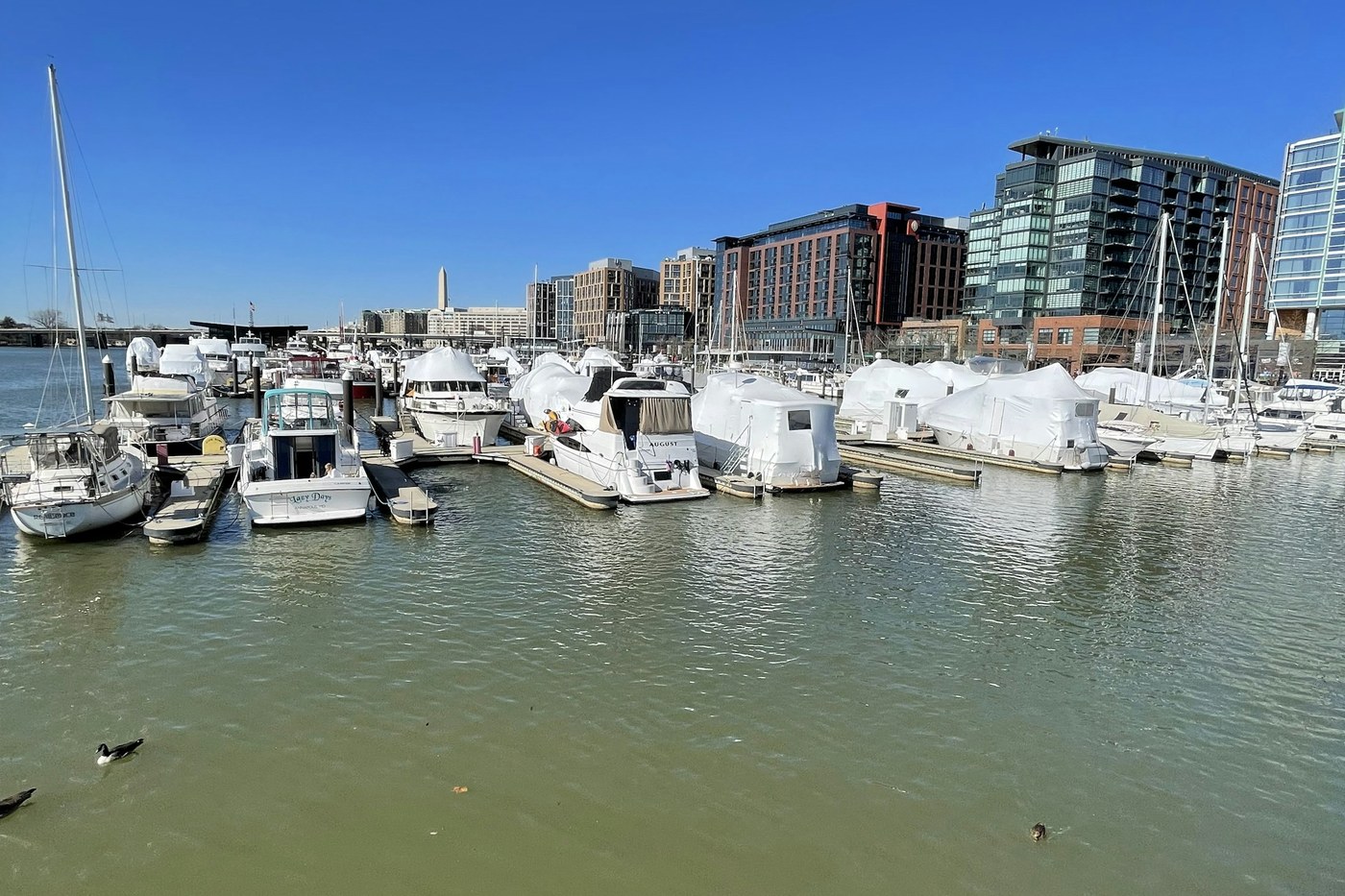
Follow the idea, not a literal trail
Dōgon is at 1330 Maryland Avenue SW, inside the Salamander hotel. The connection from the park is short, but use a current map: the Wharf’s grades, construction and pedestrian routes can make an apparently direct line less obvious than it looks.
The restaurant’s stated concept connects Banneker’s work, West African astronomy and Onwuachi’s own Nigerian, Jamaican, Trinidadian and Creole inheritance. Its name refers to the Dogon people of Mali. Treat that narrative as the restaurant’s creative frame, not as a substitute for settled genealogy or a single account of Dogon knowledge. Cultural inspiration can be meaningful without asking a dinner menu to resolve contested history.
Inside, the room makes the idea atmospheric. Lights suggest a field of stars; metallic curtains and dark surfaces soften the edges of the hotel setting. The drama is controlled rather than theatrical. It prepares the table for food that moves among West Africa, the Caribbean, the Gulf Coast and the Chesapeake without pretending those places are interchangeable.
Order for conversation
Dōgon’s official menu is organized for sharing and changes with the market. At the time of reporting, charbroiled oysters arrived with red stew; oxtail patties carried tamarind and green seasoning; a tuna preparation met Ghanaian shito; and a crab dish placed seafood over a plantain hoe cake. Names and compositions can change, which is a reason to use the live menu rather than a screenshot from an old review.
For two people, begin with two snacks or bread-centered dishes, add one or two smaller plates and then choose a larger dish if appetite allows. Ask the server to pace the meal. “Everything comes when ready” can turn a generous table into congestion unless the sequence is discussed.
Also ask about heat, shellfish and cross-contact before ordering. The menu marks dishes containing crustaceans or mollusks, but a symbol is not a complete allergy conversation. Diners with serious restrictions should contact the restaurant before the reservation and repeat the request at the table.
The bar deserves the same attention as the kitchen. A spirit-free drink can reveal the restaurant’s approach to acid, spice and fruit without becoming an afterthought. If choosing wine or spirits, describe what the table is ordering and let the pairing respond to the full meal rather than the first plate.
Recognize the luxury without mistaking it for distance
Dōgon operates within a luxury hotel owned by hospitality entrepreneur Sheila Johnson, and the room carries the polish of that setting. Yet the restaurant’s strongest gesture is not exclusivity. It is the insistence that Black history, Black ownership and diasporic cooking can occupy a grand room without being reduced to a themed occasion.
That distinction matters for travelers who have learned to evaluate luxury twice: first for beauty and service, then for whether their presence is treated as ordinary. Liberated Paths lists Dōgon as a Verified Sanctuary. A single guide cannot guarantee every interaction, but the listing, the Black leadership behind the hotel and kitchen, and the restaurant’s explicit cultural point of view give travelers more useful evidence than a generic “welcoming” label.
Arrive as you would for any serious dinner: on time, dressed for an elegant room and ready to ask clear questions. Do not make the server perform the entire history of the African diaspora tableside. The contextual work begins before the reservation; hospitality can then do what it does best.
Build an evening with enough air in it
Dōgon currently serves dinner Tuesday through Saturday from 5 to 10 p.m. Reservations are strongly recommended. A 6 or 6:30 p.m. table makes the park-to-dinner sequence easiest in spring and summer; in winter, reverse the expectation and visit the overlook in afternoon light.
The Wharf is nearby, but do not overprogram the night. A waterside walk after dinner is sufficient. The point is not to collect the park, the restaurant and the waterfront as three separate attractions. It is to notice how the city’s geography keeps returning to movement: borders surveyed, people displaced and arriving, ingredients traveling, memory finding a new room.
At Banneker Park, Washington looks composed. At Dōgon, the map loosens. The capital becomes not only a seat of power but a meeting place of routes—some forced, some chosen, all still being interpreted. Dinner does not close that history. It gives it another language.
Practical Planning Notes
- Best timing: Visit Benjamin Banneker Park 30 to 45 minutes before a Dōgon reservation, leaving buffer for the walk and hotel entry.
- Dinner hours: Dōgon currently lists Tuesday through Saturday, 5–10 p.m.; verify on the official page before departure.
- Reservations: Book ahead, especially for Friday, Saturday and larger parties.
- Accessibility: The National Park Service lists the park as wheelchair accessible. Contact the restaurant for table placement or other specific needs.
- Menu changes: Use the live menu and discuss allergies directly; seafood appears frequently.
- Dress and pace: Choose polished evening attire and allow roughly two hours for dinner.